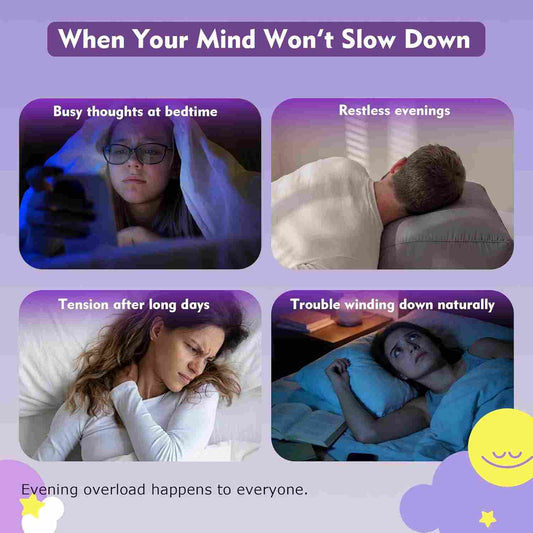
Nobody who works late follows an absolute no-screens rule, and advice that assumes otherwise gets ignored within a week. So here is the practical version.
Three rules: the phone charges outside the bedroom; the last thing you look at is not a feed; and whatever screen time remains in the final hour is passive rather than reactive. Then keep a fixed wind-down so the hour has a shape. That is enough to make a measurable difference for most people.
If you genuinely have to work late, the priority is the last twenty minutes rather than the whole evening. Dim the screen, stop reading email, and let the wind-down still happen. The routine matters more than the clock.
Sleep, in plain terms
The useful framing is mechanical rather than miraculous. Magnesium and apigenin support the wind-down side, and they help only when the timing habits are in place.
That is the biological half. The other half is serving and consistency, which is where most people actually fall short. It pairs with caffeine before noon and a consistent wake time, which is the lever most people skip.
Running sleep through a normal week
-
Check what the label actually states per serving. An evening format taken with your last meal, as a daily habit rather than a rescue.
-
Decide when, not just how much. Shift bright screens out of the last hour before bed, and let the room go dim instead.
-
Keep it visible. A bottle in a drawer is a bottle you will stop taking by the second week.
What this page is not
Here is the part that keeps this page honest. Heavy snoring, waking gasping, or falling asleep while driving needs a proper sleep assessment. If sleep stays poor despite the habits, the cause may be stress or something medical, which is a doctor's question.
These statements have not been evaluated by the Food and Drug Administration. This product is not intended to diagnose, treat, cure or prevent any disease.
Keep reading on sleep and calm
The questions we get most
How do I tell whether sleep is properly dosed?
Serving size is the number to read first with sleep, and it is often smaller than people expect. Then look at servings per container, which is where the real value sits.
Does sleep need to be taken with food?
For evening screen habits, the practical answer is the same slot each day, so it stops being a decision. Missing a day here and there is fine; missing a fortnight is not.
Are there any interactions to watch for when taking sleep?
Medication interactions are the main thing to check, and a pharmacist can do that in a few minutes with sleep in hand. Any symptom that is new, persistent or worsening deserves an appointment rather than another formula.
Built on the assumption that you would rather know what is in the bottle than be told how to feel about it.