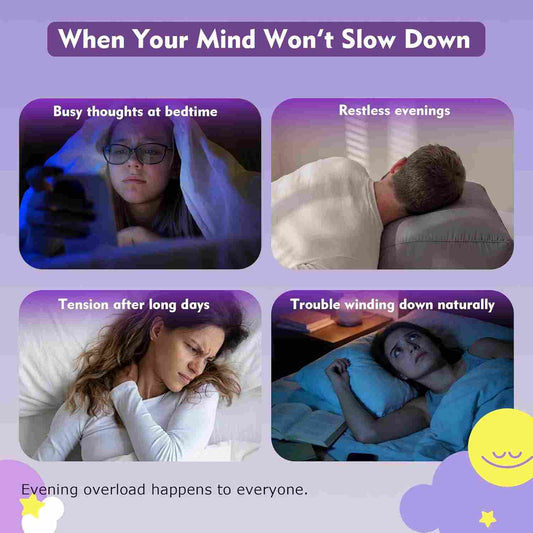
The commute used to do something nobody credited it with: it marked the boundary between work and home. Working from home quietly deleted that boundary, and most people never replaced it.
So replace it deliberately. Twenty minutes, same time daily, no work inputs — a walk, a shower, a stretch, anything that is not a screen. Then start your evening properly. The point is not relaxation for its own sake; it is giving your nervous system a clear signal that the workday has closed.
How stress is understood to work
None of this is complicated once it is separated from the claims around it. Magnesium, B vitamins and calm-side botanicals support the systems that take the strain.
Worth restating: this is normal-function support, which is a deliberately modest claim. It pairs with movement, daylight and saying no, which are the three things that actually move the needle.
Making stress a habit rather than an experiment
-
Ignore the flash and read the panel. An evening format and a morning B vitamin, taken daily rather than in a crisis week.
-
There is a window involved, and it is wider than most labels imply. Use the same short ritual at the same time each evening, so it stops being a decision.
-
Take it with food. Almost everything in this category is easier on the stomach alongside a meal.
The wider point is that a formula is an input, not an outcome. It supports a system that is already being used.
The boundary
Here is the part that keeps this page honest. If stress is affecting sleep, work or mood for weeks, that is worth professional support rather than a bigger dose. If winding down never comes and mood or sleep suffers for weeks, that is worth a doctor's appointment rather than another supplement.
These statements have not been evaluated by the Food and Drug Administration. This product is not intended to diagnose, treat, cure or prevent any disease.
Keep reading on sleep and calm
Answers, briefly
What is a sensible daily amount of stress?
What matters with stress is the amount per serving, not the headline on the front of the bottle. Standardised extracts state their strength; unstandardised powders usually do not.
Does stress need to be taken with food?
With stress, consistency beats precision — one serving, the same time, most days. It stacks comfortably with magnesium, amino acids and the rest of a normal routine.
When should I talk to a doctor about stress?
Medication interactions are the main thing to check, and a pharmacist can do that in a few minutes with stress in hand. If something feels wrong, stop and ask, rather than pushing through a bottle with a date on it.
One shelf, one job: everyday nutritional support, with the amounts printed rather than implied.